
Grand Canyon [VHS]
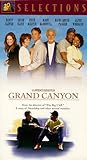
This murky rumination on keeping faith in our troubled times was an early sign that writer-director Lawrence Kasdan (Silverado) was losing his once-powerful grasp on the art of storytelling. Set in modern Los Angeles–with all its random violence, venality, ubiquitous police presence, earthquakes, and dreams–the film concerns an unusual intersection of lives and chance occurrences that alter everyone’s perspective on destiny. Kasdan, very understandably, is attempting to create an experience fo

List Price: $ 6.98
Price: $ 2.24
Find More Grand Canyon Products
Grady Harp says:
Coming to the edge 10 years later,
Ten years ago when GRAND CANYON was released many people snickered at a movie so overblown with making the world (read Los Angeles) seem so seemingly cruel and unjust. Some of us found the movie poignant and apocalyptic, but I think the press barred the public from taking the movie seriously. Well, here we are ten years laater watching this well crafted movie, surrounded by even more cosmic madness than ever before. A lot of contemporary prophecy films such as this need to be more widely viewed if we as a culture, as a world, are to survive. Living in this tenuous time where most fingers are on triggers, whether they be personal guns or national weapons, private or public disasters, or just on the thin strings that contain sanity – now more than ever we can benefit from films such as this. Caring, finding solace in acts of kindness shared at times of direst need, and yes, even putting it all in perspective by returning to the natural positive phenomena such as the Grand Canyon seems like our only reliable way of making it. This Kasdan film has more fine performances (Kevin Klein, Mary McDonnell, Alfre Woodward, Danny Golover, Jeremy Sisto, etc etc etc) and drives relentlessly to a final ending of such beauty that even ten years later we can only say “Thank you ” to Kasdan and crew.
Was this review helpful to you?

|Reviewer says:
An Insightful Commentary on Life from Lawrence Kasdan,
Early in this film one of the characters makes the observation that half of the people in the city of Los Angeles (in which the story is set) live every day on the verge of hysteria. It is further noted that the other half ARE hysterical, and the predominant aspect of their lives is attempting to control their constant fear; fear generated entirely by the very nature of their environment, and just the way things “are.” It’s a thought provoking concept of life in the `90s and beyond, and of a world in which babies are abandoned, people live in boxes on the street and the guy with the gun is in charge. And as another character so succinctly points out, “This isn’t the way the world is supposed to work–” All of which and more is considered by director Lawrence Kasdan in his evocative drama “Grand Canyon,” starring Danny Glover, Kevin Kline and Mary McDonnell. It’s a contemplation of the kind of world in which we are forced to live, the huge gaps and voids it creates in our lives, and the decisions and choices we make in an effort to fill the crevasses it all forms in our souls. This is more than just a film, it’s a statement; a reflection upon what it takes for millions of people from all walks of life to get out of bed every morning and face the day. And for those who care enough and are bold enough to look deeply into Kasdan’s eyes, there’s a message to be found here, and a powerful one it is.
In the song “Johnny 99,” Bruce Springsteen sings about a part of town where “When you hit a red light you don’t stop,” and when Mack (Kline) leaves a Laker’s game at the Forum and decides to try a short cut to avoid traffic, it is precisely in “that” part of town that his car gives up the ghost. His cell phone is dead, but he manages to find a phone booth and call for road service. But just as he gets back to his car, he becomes the target of a gang of armed young hoodlums out for an easy score or possibly more. And when things are looking about as bad as they can for Mack, the tow truck arrives, and out steps a man named Simon (Glover), who thankfully knows a thing or two about negotiating with gang members; after all, this is his turf– where he lives and makes his living. Simon takes Mack out of harms way, and it is at that auspicious moment that a convergence of two heretofore divergent worlds occurs.
Mack is an immigration lawyer who lives and works within the environs of the Miracle Mile; Simon is a part of the town in Springsteen’s song. Two individuals from different worlds whom fate brings together for a split second; and It’s a moment that is destined to change both their lives forever, and like ripples issuing from a stone dropped into a pond, it is soon going to touch and make a difference in many other lives, as well. Mack and Simon are about to learn a few things from one another, the most important of which may be found in Simon’s perspective of the human race, and the significance of “people” when compared to one of Eternity’s masterworks, the Grand Canyon.
Lawrence Kasdan and Meg Kasdan wrote the screenplay for this film, from which Mr. Kasdan proceeds to deliver one of his finest cinematic offerings. As previously stated, this is more than a film; it’s a contemplation of who we are and what we have become as a species during our time upon this planet, and where it’s all taken us. And under Kasdan’s steady guidance and insightful gaze, it is truly riveting drama that works especially well because there is something in it to which everyone will be able to identify or relate. Certainly it will strike a deeper chord with those who live or have spent time in a large metropolitan area; the situations in this film will resonate much more for someone who has lived in L.A., as opposed to those born and raised in Independence, Oregon, for example. But all will find a connection with the human issues Kasdan so incisively examines, because they are universal in nature. Quite simply, Kasdan hits a perfect pitch here. This is emotionally involving drama from beginning to end, aided in no small part by the mesmerizing score by Bill Conti and James Newton Howard that serves as a veritable pulse for the entire film.
The outstanding ensemble cast matches Kasdan’s excellence with a number of unforgettable performances, beginning with Kline and Glover. Kline gives the kind of performance we’ve come to expect from him, which is to say convincing, believable and entirely credible. He explores all of the nooks and crannies of his character and concisely expresses all that he finds there. Glover, too, hits his stride perfectly, making Simon genuine and real by finding his character’s center and effectively maintaining his focus on it.
It is Mary McDonnell, however, who nearly steals the show with her portrayal of Claire, Mack’s wife. This is an extremely complex character, and McDonnell manages to thoroughly examine all of her myriad emotional levels and express them convincingly. This is…
Read more
Was this review helpful to you?

|Ben Riddle says:
Appearamces can be deceiving.,
The first time I saw this movie, I saw the fear in Kevin Kline’s eyes as he is accosted by the black gang, heard the terror in Alfre Woodard’s screams for her daughter as their house is riddled with bullets. I saw a completely shocked Steve Martin frothing at the mouth after he was shot by a street thug for his gold watch. And sometime later I felt the fear of his wife after he had a heart attack and almost died.
The second time I saw this movie, things looked totally different. I was able to look beyond the violence, pain, and everything else that seemed to make this movie look like nothing more than a series of accidents waiting to happen, dashed with pinches of comic relief from Steve Martin. All of these things were there the second time around, but now I saw the great differences in lifestyles of middle class suburban white family and inner city black family. And I saw how the Grand Canyon is a kind of symbol of hope for them all in the future.
I believe the lesson to be learned from a movie like “Grand Canyon” is that hope never dies. Violence, suffering, crime, and pain have always been and will continue to be parts of our lives. Life is a giant, constant struggle. What “Grand Canyon” teaches us is that the struggle itself yields its own rewards. We must all strive to be more than we are now. It does not matter if we never actually reach our ultimate goal, because every little bit helps.
Was this review helpful to you?

|